Key findings
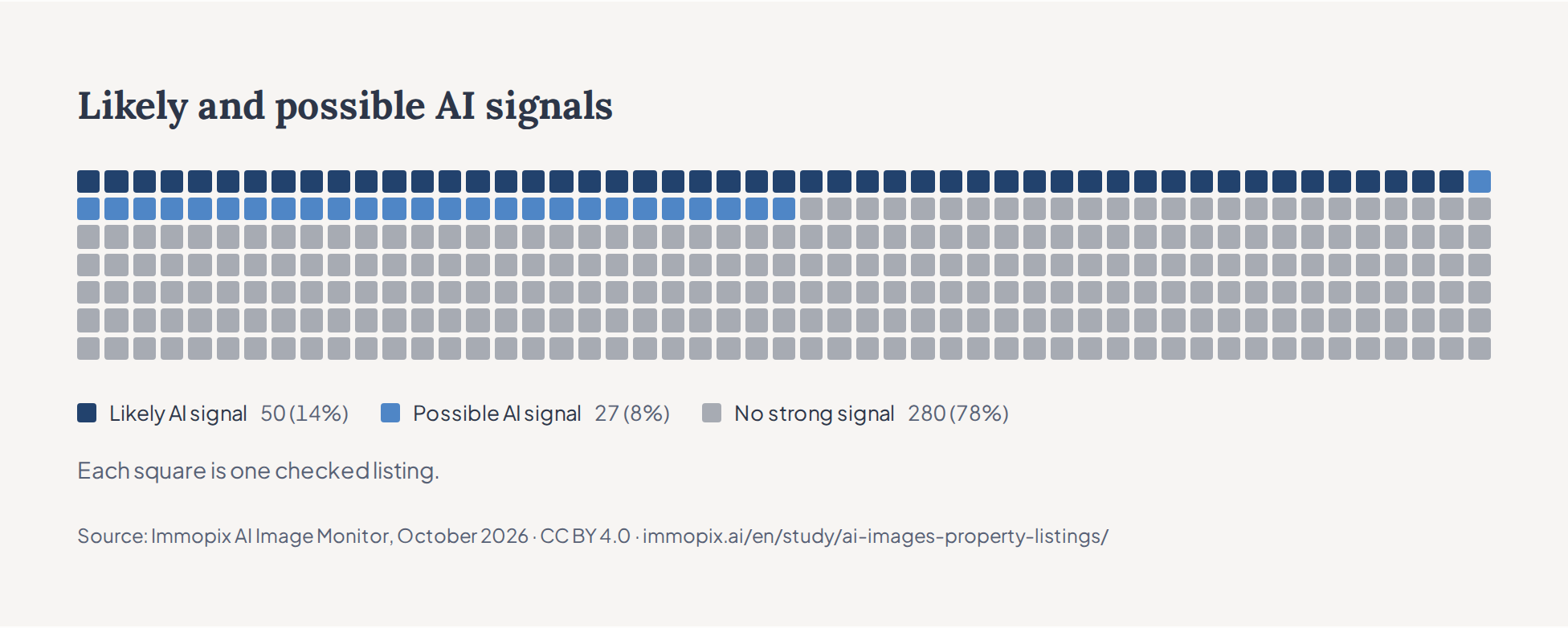
The detector found AI signals in 77 of 357 checked listings (22%). 50 listings (14%) had likely AI signals and 27 (8%) had possible AI signals.
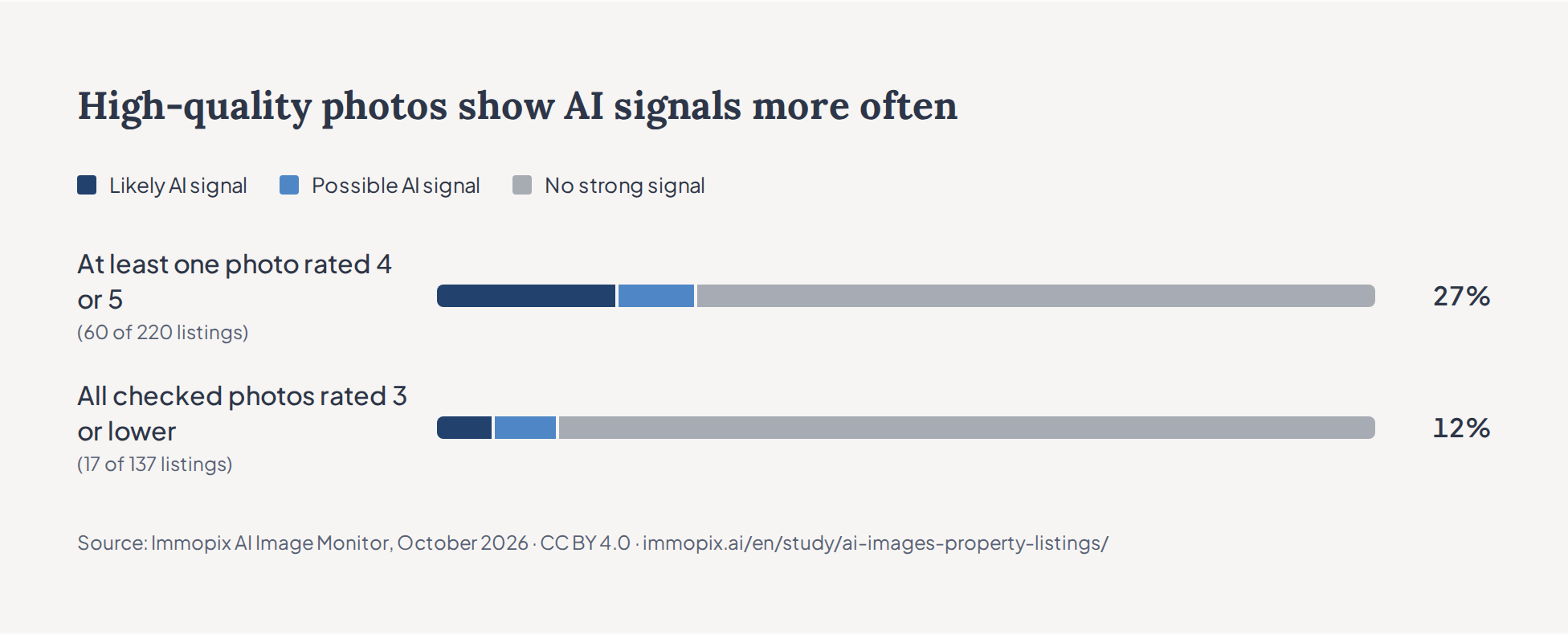
Listings with high-quality photos showed AI signals more than twice as often as listings with lower-rated photos (27% compared with 12%). With new-build projects removed, the gap was even wider: 39% compared with 13%.
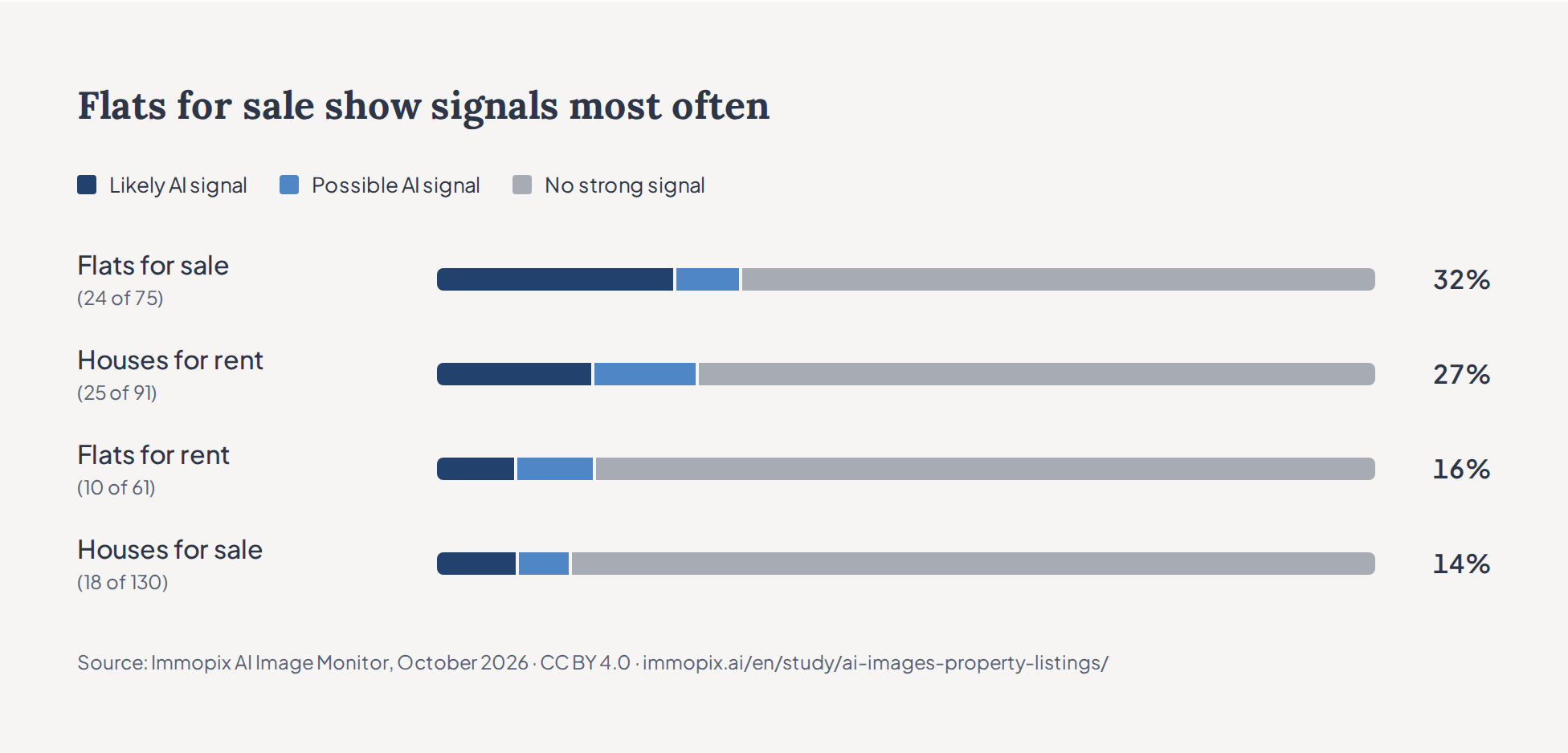
Flats for sale showed signals most often, in almost one listing in three. New-build projects rarely showed them.
About a third of the photos with likely signals were outdoor shots, for example of the facade, the garden or a terrace.
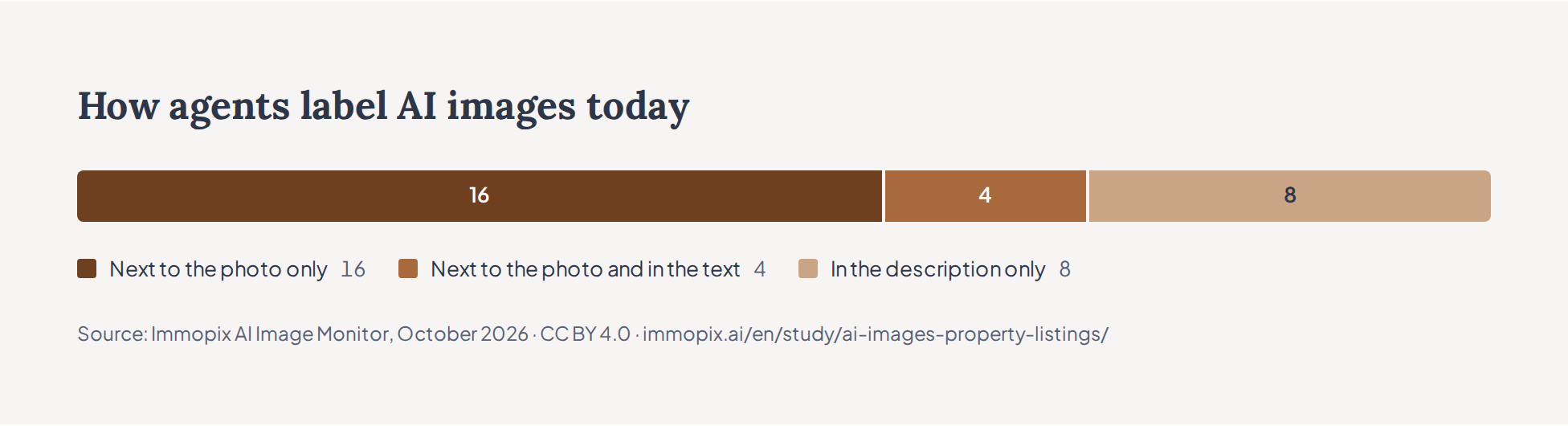
28 of 361 listings (8%) said they contain AI images. Most of them put the notice right next to the photo.
Likely and possible AI signals
We report two levels of AI signal, because a low detector score says less than a high one.
Fig. 1
- Likely AI signal 50 (14%)
- Possible AI signal 27 (8%)
- No strong signal 280 (78%)
Fig. 2
- Likely AI signal: the detector gives a photo a score of 0.60 or higher. 50 listings (14%) had at least one such photo.
- Possible AI signal: the score is between 0.20 and 0.60. Another 27 listings (8%) had such a photo but no photo with a likely AI signal.
- No strong signal: the score is below 0.20. This was true for both checked photos of 280 listings (78%).
A signal is not proof. It means a photo carries typical traces of AI editing. Because the detector scores the whole photo, the score does not tell you whether someone only corrected the light or refurnished a room.
A listing without a signal can still contain edited photos, because we checked two photos per listing, not the whole gallery.
High-quality photos show AI signals more often
For this comparison, Immopix's automatic photo rating scored each checked photo from 1 to 5, depending on how well it suits a property brochure. Listings with at least one photo rated 4 or 5 showed AI signals more than twice as often as listings where all checked photos were rated 3 or lower.
Fig. 3
- Likely AI signal
- Possible AI signal
- No strong signal
New-build projects narrow this gap. Their images often look high-quality but rarely show signals. With new-build projects removed, 39% of listings with high-quality photos showed AI signals (53 of 136), compared with 13% with lower-rated photos (17 of 132). If we keep the new-build projects and remove the listings that disclose AI instead, the gap is still clear: 23% compared with 13%.
Flats for sale show signals most often
For flats for sale, the detector found an AI signal in almost one listing in three. Between sales and rentals overall there was little difference (20% compared with 23%).
Fig. 4
- Likely AI signal
- Possible AI signal
- No strong signal
Houses for sale rank lowest mainly because of new-build projects. 82 of the 130 houses for sale were marked as projects, and only 7 of them showed signals. Among the other 48 houses for sale, the figure was 23%.
Where in the property the signals appear
Photos of bedrooms, living rooms and kitchens showed signals most often. But the detector also flagged outdoor photos: about a third of the photos with likely signals were outdoor shots (24 of 71).
Fig. 5
- Likely AI signal
- Possible AI signal
- No strong signal
Five outdoor photos, for example of a garden, a facade or a roof terrace, had an AI notice in their own caption. All five showed a likely signal.
How agents label AI images today
28 of 361 listings (8%) said they contain AI images. In 26 of them, the notice states clearly that AI was used, and two say that images may have been edited with AI. Eight more listings labelled visualisations or virtual staging without mentioning AI.
Fig. 6
- Next to the photo only 16
- Next to the photo and in the text 4
- In the description only 8
“Next to the photo” means in the caption or in the image name the portal displays. In the 20 listings that labelled photos this way, the labels read as follows (German originals, with translations):
| “KI-bearbeitet”, “KI-optimiert”, “KI-geräumt” and similar (AI-edited, AI-optimised, AI-decluttered) | 5 |
|---|---|
| “KI-generiert” (AI-generated) | 5 |
| “KI-visualisiert” or “Visualisierung” (AI-visualised, visualisation) | 3 |
| just “KI”, for example “Küche KI” (kitchen AI) | 3 |
| “virtuelles KI-Staging” (virtual AI staging) | 2 |
| “KI-Beispiel” or “KI-Idee” (AI example, AI idea) | 2 |
In our view, the clearest labels say what was changed. “Double garage, AI-decluttered” tells a buyer more than “Kitchen AI”. Our FAQ on AI photo editing in the EU explains which edits need a label under EU rules and where the label should go.
In four listings, the agents said they used AI to protect privacy. In most of these, the property was rented out, and AI replaced or removed the tenants' furniture or personal belongings.
14 of the 77 listings with AI signals said they contain AI images. A missing notice does not prove concealment: the signal can be wrong, and we did not search text inside images or PDF brochures. Half of the listings with an AI notice (14 of 28) showed no strong signal in the two photos we checked. In those listings, the notice may refer to photos we did not check.
How reliable is the detector?
Before checking listings, we tested the detector on photos whose origin we know. It flagged 49 of 50 photos that we know were edited with AI (98%): 36 with a likely signal and 13 with a possible signal. One showed no strong signal.
Fig. 7
Edited with AI: 36 likely, 13 possible, 1 no strong signal
Originals: 1 likely, 2 possible, 47 no strong signal
- Likely AI signal
- Possible AI signal
- No strong signal
The detector also flagged three of the 50 matching originals, one of them with a likely signal. We cannot say for certain that these originals were completely unedited. Many smartphones already process photos when they take them.
The 98% comes with limits, because the test was small. We also set the score thresholds on the same test photos on which we measured the 98%. The test photos were up to 1,920 pixels on the long side, and many portal photos are smaller. So the figure is a hit rate on known AI photos, not a measure of overall accuracy.
Small photos rarely show signals. For photos with a short side under 512 pixels, the detector never flagged anything (0 of 47). From 1,024 pixels up, 29% of photos showed signals. We cannot tell whether small photos are edited less often or whether the detector finds edits in them less reliably.
Fig. 8
- Likely AI signal
- Possible AI signal
- No strong signal
Before each check, we removed all metadata from the photos. The detector therefore saw only the image itself, not any embedded AI labels.
What this means for agents
One in five checked listings shows AI signals, and 28 listings state that they contain AI images. If you edit photos with AI, you are not the only one.
In our pre-test, the detector flagged 49 of 50 known AI edits. Because AI edits can often be detected, we recommend being open about them, with a short label right next to the photo that says what was changed.
In our sample, listings with high-quality photos often showed AI signals, so good photos and AI editing can go together.
Immopix makes it simple to be open about AI edits. Every edited photo carries a machine-readable AI note in its image data, plus a C2PA content credential, an open standard for provenance information in image files. When you export, you can add a visible text notice such as “AI edited” to the image. In an exposé (property brochure) that you create with Immopix, a notice appears by default as soon as a photo has been edited with AI.
Try it with one of your own photos.
Enhance a photo for freeHow we measured
-
1
Collect listings. We collected recent listings from Immowelt and ImmoScout24, two major German property portals: flats and houses, for sale and for rent, from at least twelve German states.
-
2
Pick photos. For each listing, we randomly drew two photos of the property. Floor plans did not count.
-
3
Prepare photos. We scaled each photo down to at most 1,920 pixels on the long side, never up, and removed all metadata.
-
4
Check. The detector gives each photo a score between 0 and 1.
-
5
Classify. A listing counts as “likely” when at least one photo scores 0.60 or higher. It counts as “possible” when its highest score is between 0.20 and 0.60.
Details for specialists
- Period: 19 July to 19 October 2026. Many listings show no publication date. In those cases we used the date the listing was created. “Recent” therefore means published or created in this period.
- Sample: 361 listings, of which 357 could be checked. Four listings had no usable photos. The 357 checked listings contain 706 checked photos. Because some photos appear in several listings, there are 636 distinct photos. Wherever we talk about photos, each photo counts once.
- Selection: the sample is not a random sample of all German listings. Which listings we could reach depended on search, page availability and our budget. We spread the selection across property type, sale or rent, and region. It is too small for statements about individual regions.
- Uncertainty: if the sample were random, the 95% confidence interval for the share of listings with AI signals would be 18% to 26% (Wilson interval). Because it is not random, the real uncertainty is larger.
- Detector: AI or Not, checking for AI-generated content. The scores are not probabilities. We set the thresholds 0.20 and 0.60 before checking the listings.
- Photo rating: the levels 1 to 5 come from Immopix's automatic photo rating. It rates only the two checked photos, not the whole gallery.
- New-build projects: listings that the portal marks as “Projektiert” (planned). A listing without this mark is not necessarily a finished building.
- Duplicate photos: identical files count once in photo figures. We did not merge photos that are similar but not identical.
- Labelling: we searched the descriptions and captions of all 361 listings and checked every match by hand. We did not analyse text inside images or PDF brochures. “No notice” therefore only means: no notice in the text we checked.
- What we do not claim: we do not say that any particular listing uses AI, and we do not name individual listings. Photos without a signal are not automatically unedited. We do not measure a trend over time: new and older listings showed signals at about the same rate (between 18% and 22%).
Editions
| Edition | Period | Listings checked | With AI signals |
|---|---|---|---|
| October 2026 | 19 July to 19 October 2026 | 357 | 22% (14% likely, 8% possible) |
We plan to repeat the measurement with the same method.